English
 Company Profile
 Company News


 FAQ
FAQ
 Video
Video
 Service
 PDF
PDF
When considering custom made dog toys, one of the first and most critical questions we hear from brands and retailers is: "How much will it cost?" We understand that for your business, having a clear cost framework is essential for planning and decision-making.
At Lucky Venus, we believe in transparency. While providing an exact price without understanding your specific project is impossible, we can demystify the pricing structure. This guide breaks down the key factors that influence the cost of custom pet toys, helping you build a realistic budget and understand how to get an accurate quote.
The final price per unit of your custom dog chew toys is a combination of these elements:
The materials you choose directly impact safety, durability, and price.
Standard Plastics (TPR, PP): Cost-effective and versatile, suitable for many squeaky toys and chew items. Good for entry-level product lines.
Natural & Food-Grade Rubber: Higher cost, but offers superior safety, elasticity, and durability for aggressive chewers. A premium selling point.
Eco-Friendly Materials (rPET, natural cotton, biodegradable blends): May carry a price premium but align with growing market demand for sustainable products, potentially allowing for higher retail pricing.
Plush & Fabrics: Costs vary widely by quality, pile density, and safety certifications (e.g., fire-retardant).
Tip: Discuss your target price point and dog size/chew strength with our team. We can recommend materials that balance cost, safety, and performance.
The complexity of your design is a major driver of upfront (tooling) and per-unit costs.
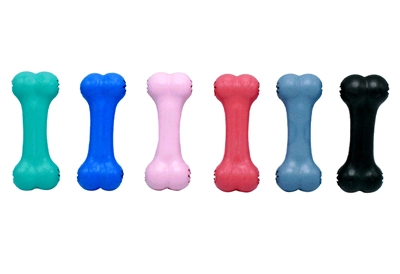
Simple, Single-Material Designs: A basic ball or bone shape requires a simpler mold, minimizing initial investment.
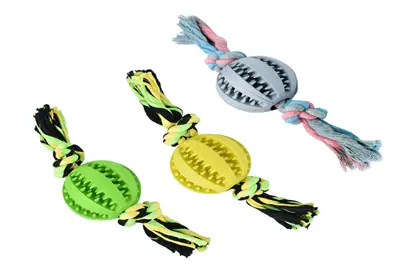
Multi-Part & Assembled Designs: Toys with multiple components (e.g., a rope attached to a rubber piece, a plush toy with a separate squeaker compartment) require more complex molds and assembly steps, increasing cost.
Integrated Features: Adding built-in squeakers, rattles, or electronic components (like motion sensors) adds both component costs and assembly complexity.
Tooling (Mold) Costs: This is a one-time upfront investment. More intricate designs with undercuts or fine details require more expensive, precision molds. We help optimize designs for manufacturability to control these costs.
This is where manufacturing in bulk becomes a powerful cost advantage.
The MOQ Principle: Minimum Order Quantity exists because setting up a production line has fixed costs. Spreading these costs (like mold amortization) over more units drastically reduces the cost per toy.
Typical MOQ Range: For custom dog toys, MOQs can range from 1,000 to 5,000+ units per design/color, depending on complexity. At Lucky Venus, we offer flexible MOQ solutions to help startups and established brands alike.
Scale Benefits: Doubling your order quantity rarely doubles your total cost. The per-unit cost decreases significantly as fixed costs are diluted.
How your toy is decorated affects both appeal and price.
Simple Color Infusion: A single-color toy is the most economical.
Painting, Printing, or Pad Printing: Adding logos, patterns, or facial details in multiple colors increases per-unit cost with each additional color layer.
Embroidery: Common for plush toys, it offers a premium, durable look but is more costly than printing.
Surface Textures: Special mold textures (e.g., to mimic animal fur) are part of the mold cost and don't significantly affect per-unit run cost.
Packaging protects your product and sells it on the shelf.
Simple Polybag: A clear, printed polybag is the most cost-effective option.
Custom Folding Boxes (Cardboard): Creates a premium unboxing experience. Cost depends on box size, cardboard quality, and printing complexity (e.g., full-color vs. spot color).
Blister Cards or Clamshells: Excellent for visibility but typically higher cost due to plastic and additional labor.
Bulk Shipping Cartons: Standard export cartons are included; special labeling may incur a small extra fee.
To move from estimation to a formal quote, preparation is key. The more information you can provide initially, the faster and more accurate our quotation will be.
Define Your Vision:
Provide a Sketch, Reference Image, or Brief Description: Even a simple drawing helps immensely.
Specify Your Target Dog: Size, age, and chew style (gentle, moderate, aggressive).
List Desired Features: Squeaker? Rope? Crinkle material? Specific dimensions?
Outline Your Specifications:
Preferred Materials: If you have samples or know what you want, tell us. If not, we'll advise.
Target Quantity: Provide your ideal first order volume. We can show price breaks at different quantities.
Packaging Concept: Describe your ideal retail packaging.
Share Your Sample & Timeline Needs:
Do you require physical prototypes before bulk production?
What is your target launch or delivery date?
Send this information to our sales team, and we will promptly provide a detailed, line-item quotation, clearly separating one-time costs (like tooling) from recurring per-unit costs.
With over 12 years as a specialized custom pet toy manufacturer, we don't just quote—we optimize. Our expertise adds intangible value that affects your bottom line:
Design for Manufacturability (DFM) Advice: We often suggest small, cost-free design tweaks that significantly reduce production complexity and cost without changing your product's look or function.
Supply Chain Efficiency: Our long-standing relationships with material suppliers secure better prices and consistent quality, savings we pass on to you.
Production Expertise: An experienced factory makes fewer errors, reduces material waste, and maintains tighter quality control, ensuring you pay for perfect products, not rejects.
Getting a quote is the first step in a partnership. We are committed to helping you create a custom made dog toy that is not only loved by pets but also profitable for your business.
Ready to Translate Your Idea into a Cost-Effective Product?
Contact us today with your project details for a confidential, no-obligation quotation. Let's build something great together.